Threshold: A collection of paintings by Cheryl McAlister
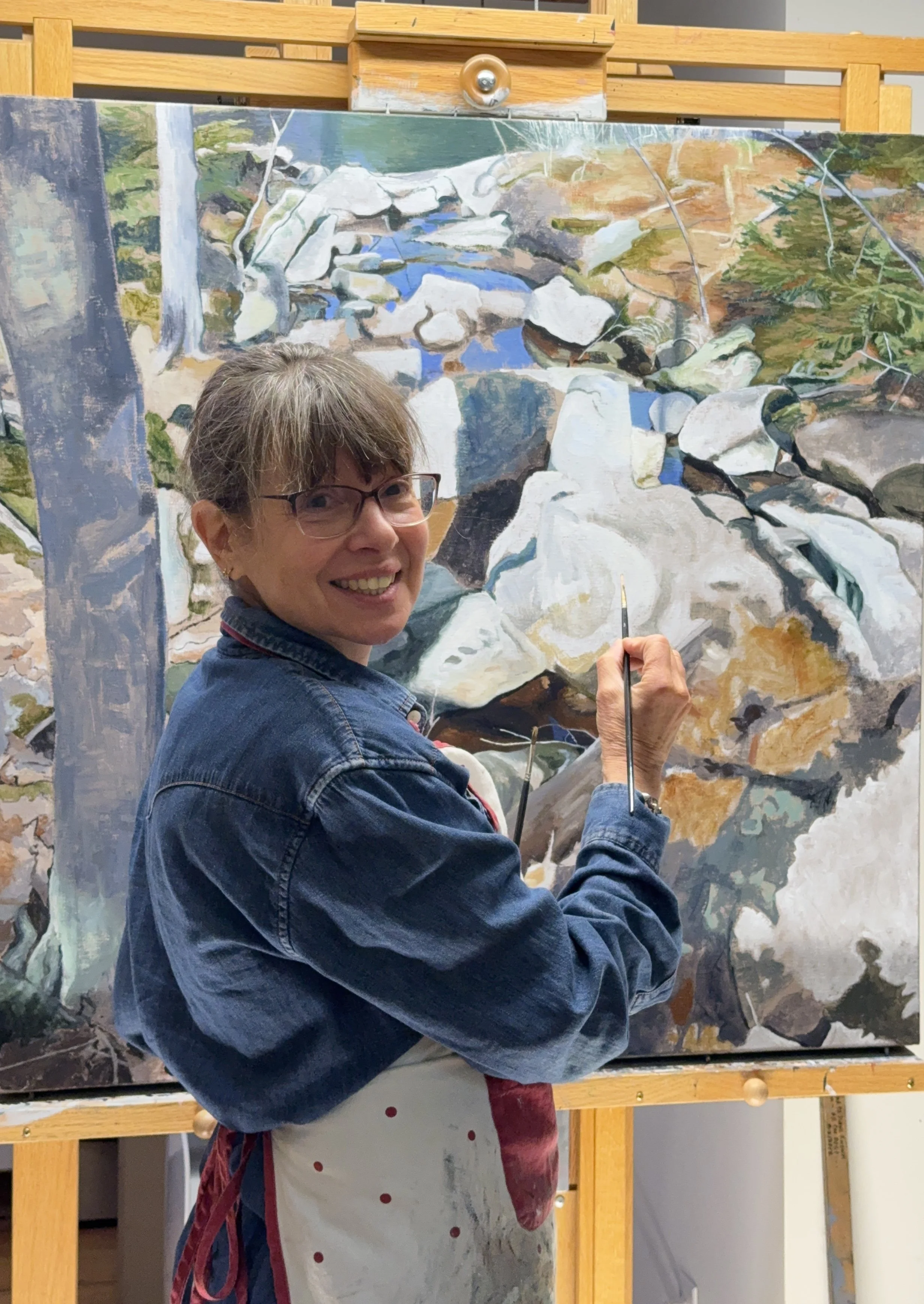
This is me finishing the last painting of the series, Sentinel.
Threshold represents my personal visual language manifested through constraint and the medium of paint. I apply three consistent limits on my work. The first is subject matter. I paint the Maine landscape, particularly the forest. Second, I have chosen to work in a limited palette. In Threshold, I used only white, Payne’s gray, burnt sienna, burnt umber, ultramarine blue (including ultramarine light), and sap green. Finally, I have confined myself to working in a square format, specifically 36” x 36”, and it is this constraint that contains all the others.
I chose to work on a square because it is the most neutral of formats. It doesn’t impose a narrative direction the way a landscape or portrait rectangle does; it is an open arena for my creativity. A horizontal rectangle says “landscape” before a single mark is made. The square refuses that shortcut. It says nothing about orientation, nothing about horizon, nothing about the relationship between earth and sky. The square puts the full burden of meaning on what happens inside it. It is the silent container within which the gesture occurs.
I am not immune to the iconic charm of Maine’s shoreline, but I prefer to challenge myself to paint her forests. I use the crossing branches, shadow patterns, massive boulders and meandering streams I find to help me build an armature for my compositions. I want to create a locus of energy on the canvas and am interested in the relationship of the forms in my paintings. I am curious about how they interact on the canvas and how they pull my eye around and through the image in the same way I am pulled from here to there as I “read” the forest.
Depending on the season, the Maine woods present certain dominant color palettes. During “Stick Season” (late fall through early spring) I have found that blue, gray, white, and brown are predominant. In the spring and summer, greens take over, and in autumn, the forest blazes with yellows, reds, greens, and blues. At that season, a painter could easily use every tube of paint at their disposal and still yearn for more color. But I have found that my limited palette has forced me to be creative in my use of color, and my paintings hold together as a cohesive collection as a result. Additionally, I have discovered some interesting mixtures that yield surprising results (burnt sienna mixed with sap green and white yield a wonderful yellow).
Many years ago I attended a seminar where the speaker said, “The tighter the context, the greater the impact.” This has been my mantra ever since. I have found that constraint is generative, so with Threshold, I have chosen to limit myself in subject matter, palette, and format. Of these, the primary constraint is the square. Threshold is essentially an artistic conversation that I am holding with myself about my world and how to talk about it in paint.
1 Arnheim, Rudolph, “The Power of the Center: A study of composition in the visual arts”. Berkeley: University of California Press, 1988, p. 13