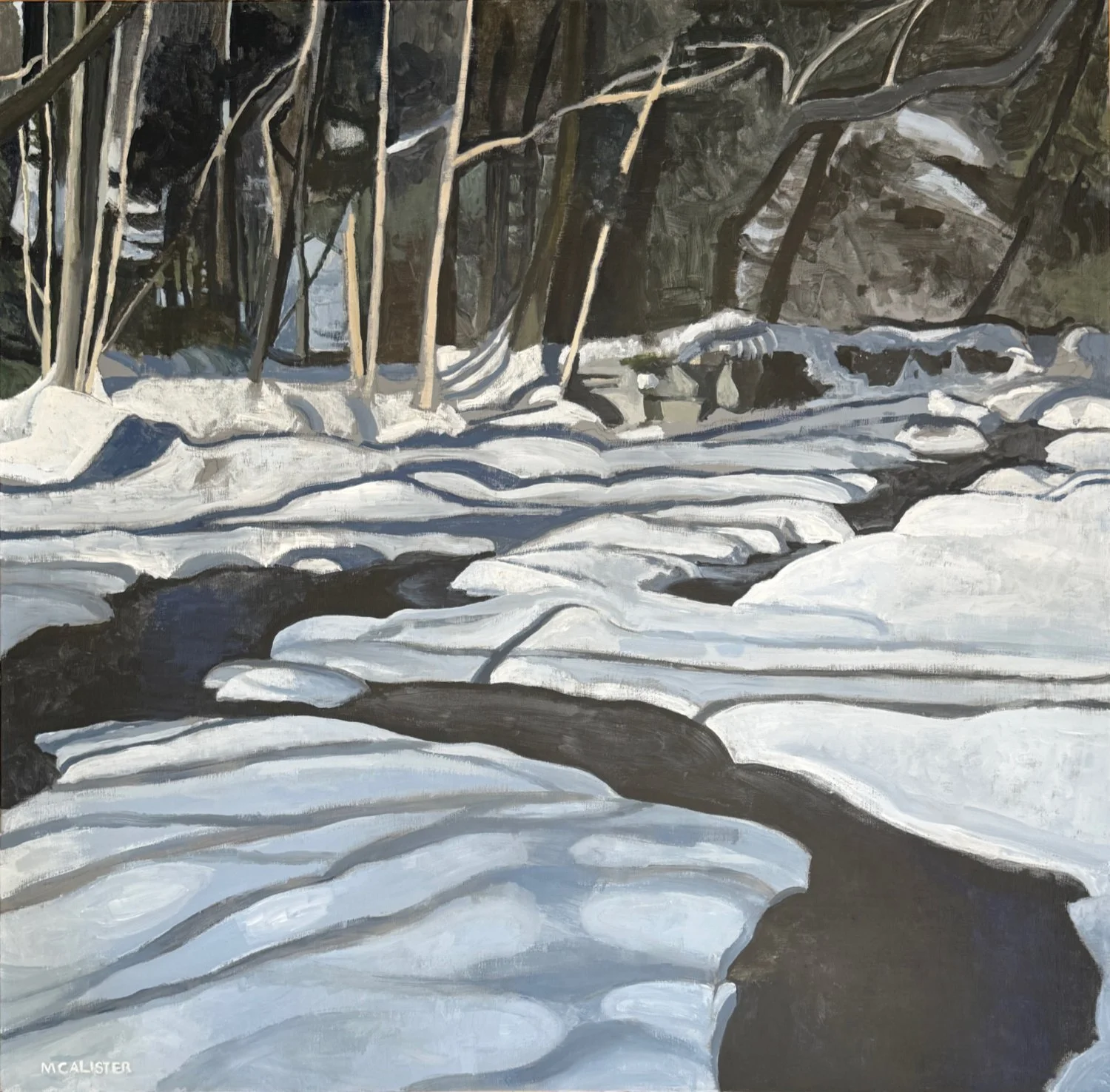
Dark Water January, Acrylic on Linen, 36” X 36”. Note the compressed palette, simplified shapes, and internal geometry.
My paintings are the result of a productive paradox. On the one hand, I strive to keep them “open” without resolving every last mark so that the viewer is free to regard them from the perspective of the viewer’s own subjectivity. On the other, I adhere to certain self-imposed constraints, a kind of personal formalism: a square format, a palette restricted to five hues, high contrast and simplified shapes. Paradoxically, the tightened context in which I work opens my paintings to infinite creative possibility. It is this possibility that has led me away from strict realism to paintings that flirt with abstraction.
When I evoke Formalism, I fear that I am playing with fire. When I was a RISD undergrad I was introduced to the Formalism of Clement Greenberg by several of my professors who “grew up” under his influence. I understood that paintings should be flat, that the medium should determine the direction a painting would take, and that reference to anything other than the thing itself was to be avoided. This was stifling to a kid who had barely lived long enough to have anything to say in the first place.
I find the romantic (my word for it) Formalism of Clive Bell a little easier to accept than that of Greenberg, though it is still problematic. Bell came up with a concept he called “significant form” or the notion that certain combinations of formal elements produce what he called “aesthetic emotion”. Bell believed that to appreciate a work of art we need not reference life—no knowledge of its ideas and affairs, no familiarity with its emotions—nothing but a sense of form and color and a knowledge of three-dimensional space were necessary. Significant form would carry all necessary meaning. Significant form alone would produce a feeling of awe in a viewer. Anything else was extraneous…even, apparently, the painter’s own experience.
Recently, my husband and I took a long car trip. During the ride I tried to explain to him the direction I have been taking in my work by explaining my own personal approach to formalism. I explained that I want my paintings to be built upon a geometry that will lead the eye through the work and support the picture like an armature. I want to experiment with color, to push its possibilities by limiting the range of hues in my palette. And I want to create and occasionally deny the illusion of space through value and the visual cues that we have learned to “read” by years of looking at three dimensions represented on a two-dimensional surface… And there it was. My departure from the Formalism of Clement Greenberg and Clive Bell.
My formalism leaves room for lived experience—in fact, it depends on it. I believe that the mathematics of the rule of thirds, the golden mean, or the illusion of space and our understanding of value and hue are learned concepts that we internalize as we experience the world. Their resulting design becomes normal and desirable to us. I agree with Bell and Greenberg that formal principles matter enormously, but unlike them, I believe they work on us through our embodied experience of being in the world and that they cannot be separated through the assertion of cold knowledge. And yet, despite our differences, I think that Greenberg, Bell, and I eventually arrive at the same place. A tightened context—limited palette, simplified shapes, high contrast, and an attention to the actual experience of painting—do not close a painting down. Rather, they open it up. By eliminating the extraneous, a painter creates a silent space around the essential, and this is where the viewer’s subjectivity may enter.
Sources:
Greenberg, Clement, “The Crisis of the Easel Picture” 1948, in Art and Culture, pp. 154-157.
Dowling, Christopher, “Aesthetic Formalism” in the Internet Encyclopedia of Philosophy, https://iep.utm.edu/aesthetic-formalism/