I always have my phone with me because I depend on the camera that is built into it to capture images that support or challenge the questions I am working on in my paintings. Early in my career I avoided working from photographs because I was taught that direct observation was paramount. While I agree that young artists benefit from learning to translate three-dimensional form, value and color onto a two-dimensional surface, I have come to a place in my later stage art-making where camera phones and editing software have become very useful to me, and I am happy to be part of a long tradition of artists who have used technology as a tool in their process of creation.
David Hockney spent years investigating the use of lenses and the camera obscura in the paintings of artists from 1300 to the 1830s including Van Eyck, Da Vinci, and Caravaggio to name but a few. He is perhaps most known for his research into the work of Johannes Vermeer, who may have used a camera obscura. Hockney’s research was supported by Philip Steadman’s parallel inquiry. Steadman reconstructed a scale model of the room Vermeer painted and photographed it. His results were very consistent with Vermeer’s paintings. While there is no contemporaneous evidence for Hockney’s and Steadman’s hypotheses, it seems to me very likely that artists of any age would experiment with the technology of their day, not to copy, but to inform. [1]
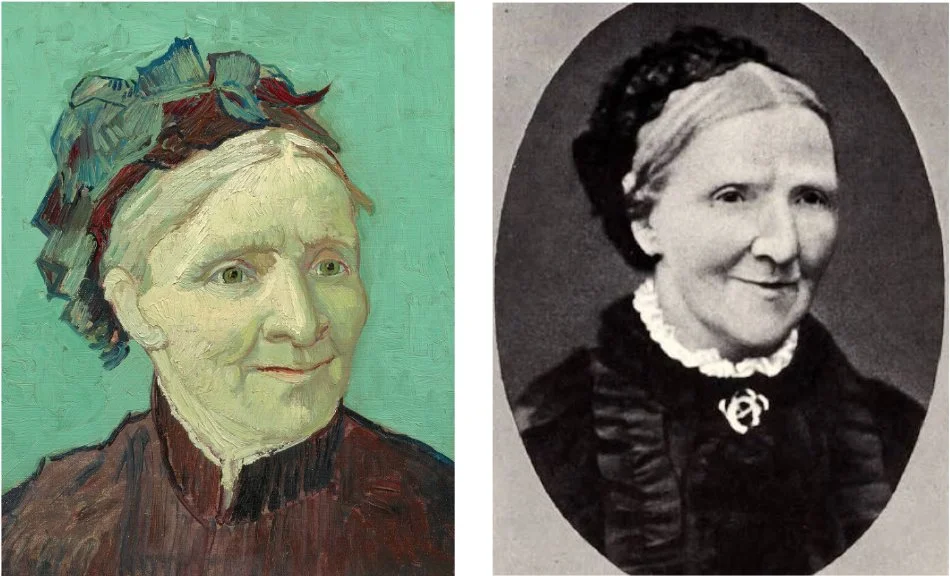
Portrait of the Artist’s Mother by Vincent van Gogh, 1888, painted from a carte de visite.
While early photography was seen as a medium in itself, painters began using it as reference by the mid-nineteenth century. [2] Photographs captured a fixed moment with mechanical precision that could be used when painting outside was impossible or when a model was unavailable. Artists like Degas, Gauguin, Cézanne, and Van Gogh used photography to inform some of their work. [3]
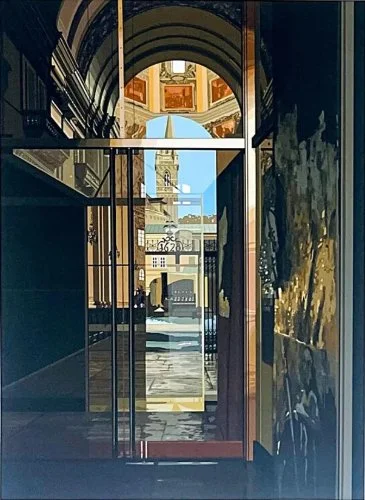
Salzburg Cathedral by Richard Estes, 1983
Richard Estes famously uses photography as source material, but he produces paintings that are more than direct copies of photographs. He creates composite images that synthesize multiple views and light conditions into a single object that has no photographic equivalent; Estes’ complex imagery would be impossible to capture in any single photograph.
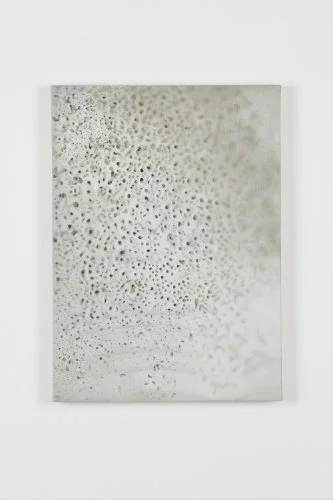
Shell by Vija Celmins, 2009–2010
Vija Celmins paints from photographs that she has taken herself or found. She returns to a single source over and over again. Choosing the crop and the medium, she allows the decisions that separate the artwork from the source image to remain visible in her transcription.
I use my photographs as a means of controlling variables such as light, wind, and even bugs. Paint allows me to investigate what a photograph cannot show: the structural logic underneath the image, the formal relationships, the act of simplification, and the decision making that turns observation into artistic inquiry. For me, such investigation only happens through paint. Unlike the instantaneous image capture of a photograph, painting is slow, resistant, and embodied. The photograph serves as a mediator and a point of departure.
When I first started using photographs as reference I had to fight the urge to copy them directly. To be honest, I made several pastel paintings that were close copies. I say close because no painting will be an exact replica. Idiosyncrasies and mismatches introduced by the artist’s hand will always be present, but I was abandoning artistic decision-making to the camera and depriving myself of the challenge of real artistic creation. Today, I use photographs that I have taken to inform my work. I crop these to find the tightest possible composition. One of my working constraints is the square, so the cropped composition must lend itself to this format. I use the photograph to lay out my underpainting as a value study, but at some point I set it aside to allow the painting to speak to me directly about what it “needs.”
When I was in graduate school I got used to examining my motivations by looking at other artists, writers, and philosophers, and this practice has not left me. For my series, Elemental, I chose to read Edmund Burke on the nature of beauty and the sublime. Burke has been particularly interesting as I investigate my process of using manipulated photographs as reference material for my paintings.
In A Philosophical Inquiry Into the Origin of Our Ideas of the Sublime and Beautiful, Burke rejects the idea that beauty necessarily results when “deformity” is removed. He writes, “[f]or deformity is opposed not to beauty, but to the complete common form.” [4] By common form, he means the natural proportions we expect to see. If removing deformity leaves only the common form, then beauty must be something more than the absence of fault. Like deformity, beauty stands apart from the usual, and we are struck by both for this reason.
My reference photos are useful and meaningful to me, but they are also predictably decent shots. Today’s smartphone software is designed to deliver bright, clean pictures that will appeal to a wide audience. They aim to prevent “deformities” such as over or under exposure, motion blur, low-light grain, color cast and white balance errors. (Note that I am extending Burke’s notion of flaws in an object to flaws in an image.) Phone cameras automatically detect what we are shooting and adjust the photo using algorithms and HDR to make it almost impossible to take a bad picture (even if that is exactly what you want). The result is generally attractive yet unsurprising. The camera phone is a valuable tool, but ultimately my decisions as an artist are where a departure from the usual occurs.
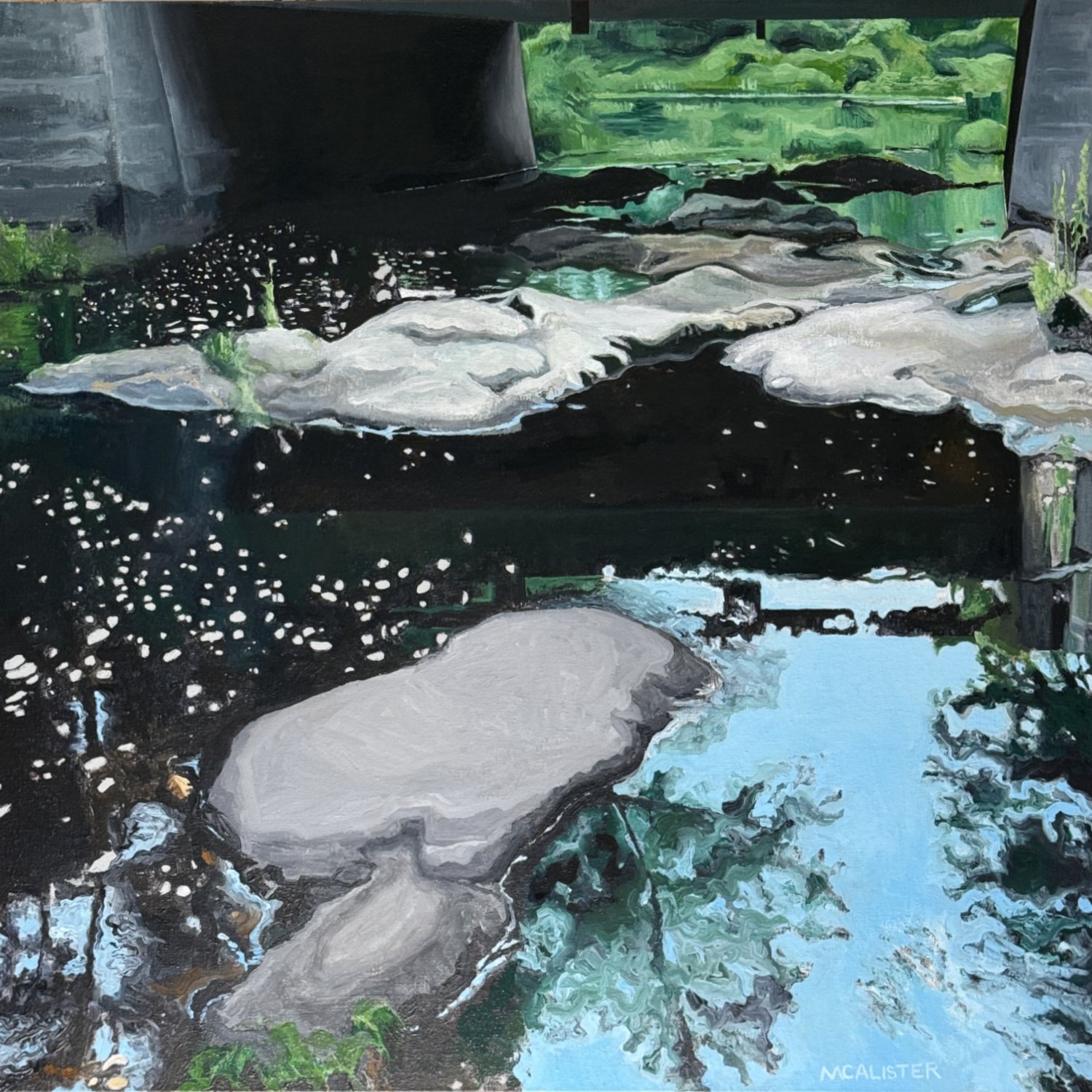
Manmade, acrylic on linen, 36” x 36”, 2026
In my painting, Manmade , I simplified the forms of the rocks, foliage and reflections so they would work both as the things I was representing but also as graphic elements supporting the structure of the composition. For example, I smoothed the front rock (a source of beauty for Burke that I did not consider when I made this painting) and reshaped some of the rocks behind it to echo forms I saw in the foliage, choices true neither to the rocks nor to my photograph.
Reading Burke has not changed how I paint, but it has given me a way to say what I was already doing. A photograph gives me the reference: the rocks and light as they were at that instant, rendered accurately and agreeably, yet accuracy is not what holds my attention. What holds it is the memory that is jarred, the question that is inspired, the moment where something in the scene departs from what I expected. The painting is my attempt to find out what that departure is. When I smoothed the rocks in Manmade, I did not know I was making a choice Burke would recognize. I knew only that the photograph held more than the picture needed, and that the picture needed something the photograph could not supply. Burke counts imitation among the sources of our pleasure in art, but he also saw that people are not content with imitation. He says that we have been imbued (by our creator) with ambition, so we are driven to move beyond imitation in the pursuit of excellence. [5] The photograph tells me what is there. The painting is where I decide what matters.
[1] Teuber, Andreas. “Camera Obscurities.” American Scientist. https://www.americanscientist.org/article/camera-obscurities, accessed October 14, 2026.
[2] Courtauld Institute of Art, “Photography and the French Avant-Garde from Delacroix to Cézanne,” https://courtauld.ac.uk/whats-on/photography-and-the-french-avant-garde-from-delacroix-to-cezanne/, accessed October 15, 2026.
[3] Edwards, Angela. Blog post, “Do fine art painters paint from photographs?”, June 19, 2020. https://www.angelaedwards.co.uk/do-fine-art-painters-paint-from-photographs/
[4] Burke, Edmund. A Philosophical Inquiry Into the Origin of Our Ideas of the Sublime and Beautiful, Part III, §V.
[5] Burke, Part I, §§XVI–XVII.