Four painters who matter to me
When I was teaching I used to tell my students that it was important that they get to know their community. This was my way of encouraging them to learn about the work of artists they found inspiring or that spoke to them in some way. Of course, I wouldn’t tell my students to do something I don’t do myself. Neil Welliver, Richard Diebenkorn, Eric Aho, and David Frazer are four artists whose work inspires and informs my own painting.
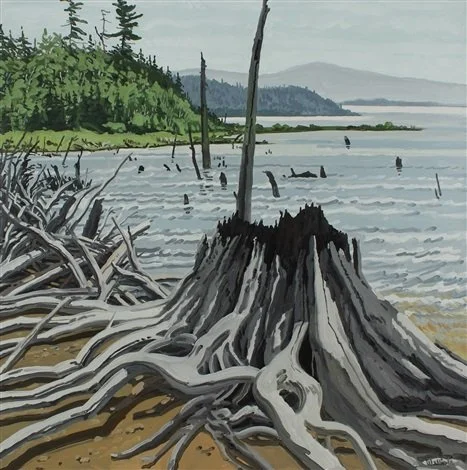
Neil Welliver, Flotsam Allagash, Woodcut, 1995
I feel a kinship with Neil Welliver who also painted the Maine Landscape. Like him, I aim for simplicity and a balance between abstraction and realism. I am also committed to getting the most from a very limited palette. I greatly admire how Welliver was able to capture honest Maine-ness devoid of lobster boats and lighthouses. There is a coldness about his paintings that put me off when I was younger, but that I understand now that I live in Maine. The light here is cold, even in summer. While beautiful, there’s a harshness to the Maine environment, an isolation, that comes through Welliver’s paintings clearly.
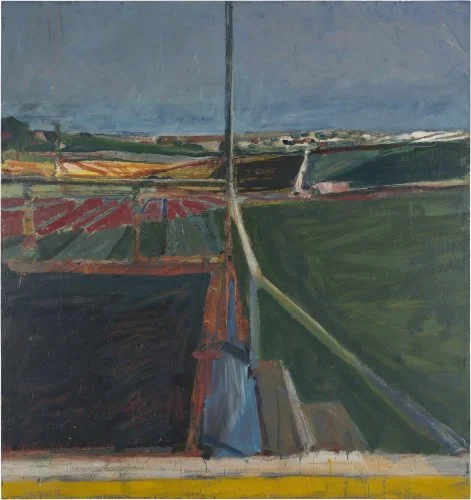
Richard Diebenkorn, View From the Porch, Oil on Canvas, 1959
I am inspired by Diebenkorn’s courage as a painter. This painting is an example of one where the subject might be landscape as indicated by the strong horizon and blue top area, but Diebenkorn seems to have been equally interested the tight geometry of the canvas. I find I can read the picture plane as deep if I allow myself to see it as landscape and very shallow if I look at it as pure design. I am intrigued by this tension.
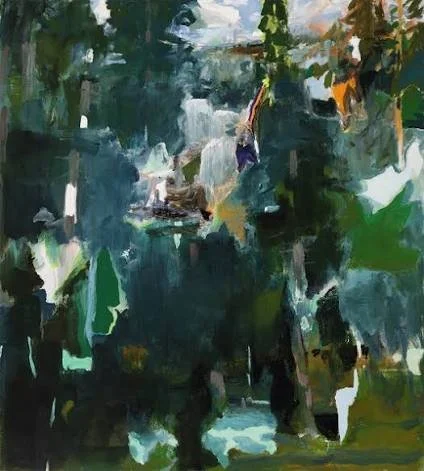
Eric Aho, Source, Oil on Linen, 2018
Aho also takes inspiration from the landscape. He paints in New Hampshire, Vermont, Finland, and Maine. He uses the landscape as a fulcrum to create a personal vision that is evocative yet completely personal. I am drawn to the different energies in his canvases: some are very calm while others are wild. I get the feeling that Aho simply lets go and paints like a madman. But the paintings are always structurally strong—held together by an underlying logic. In this painting the powerful dark verticals guide your eye across the canvas with pauses at the bursts of light and color.
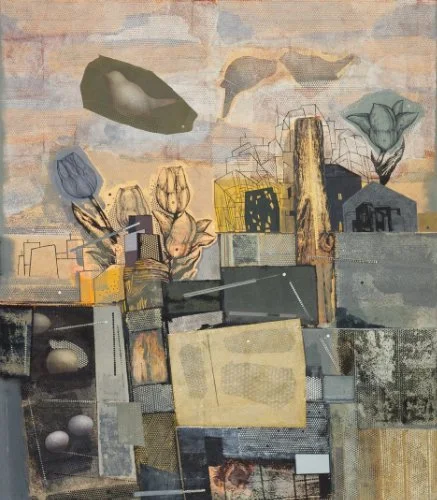
David Frazer, Harborside, Oil on Canvas, 2025
The final painting is an example of the work of one of my teachers from RISD, David Frazer. This work, Harborside, oil on canvas, 2025 is a good example of the way Frazer has developed a personal iconography. I remember some of these glyphs from when I was a student and I’m fascinated that my teacher has never abandoned them. I like that his work manages to talk about something without being illustrative and that the symbols are repeated throughout his oeuvre like some sort of hieroglyphics that I am free to interpret as I wish.